The 12 Essential Facilities Management KPIs Every Operations Team Should Track
Facilities Management
Dec 1, 2025

Facilities teams are under increasing pressure to reduce downtime, extend asset life, control costs, and improve service delivery. Tracking the right Facilities Management KPIs is how high-performing operations teams stay accountable, make data-driven decisions, and demonstrate the value of maintenance work to leadership.
In this guide, we break down the essential KPIs every modern FM and maintenance department should measure, how to calculate them, why they matter, and how to use them to transform facility performance.
If you’re new to the discipline, our Facilities Maintenance 101 guide provides a complete overview of the roles, responsibilities, and workflows involved.
Why Facilities Management KPIs Matter
Facilities teams often operate behind the scenes, but their impact is highly visible across every area of an organization. Without clear KPIs, teams struggle with:
Reactive maintenance overload
Unpredictable asset failures
Vendor performance inconsistency
Limited budget justification
Difficulty proving operational impact
Unclear accountability across staff and contractors
The right KPIs enable FM leaders to:
Prioritize work based on impact
Improve technician productivity
Reduce emergency repairs
Increase asset reliability
Optimize preventive maintenance
Communicate performance to executives
Improve vendor compliance and costs
KPIs become the foundation for operational excellence. Facilities Management as a discipline follows global standards such as the ISO 41001 Facility Management framework, which emphasizes performance measurement and service delivery.
The 12 Essential Facilities Management KPIs
Below are the KPIs used by world-class operations teams in manufacturing, hospitality, healthcare, commercial real estate, education, and corporate facilities.
1. Work Order Completion Rate
This is one of the clearest indicators of team productivity and operational flow.
Formula:
Completed Work Orders ÷ Total Work Orders × 100
Why it matters:
A low completion rate signals staffing issues, poor scheduling, unclear priorities, or inadequate vendor follow-through.
Benchmark:
80–90% for most facilities teams.
2. Preventive Maintenance (PM) Compliance
Measures how consistently the team completes scheduled PM tasks on time.
Formula:
PM Tasks Completed on Time ÷ Total PM Tasks × 100
Why it matters:
High PM compliance leads to reduced downtime, extended asset life, and fewer failures.
Benchmark:
90%+ is considered strong.
3. Reactive vs Preventive Maintenance Ratio
Shows whether your team is reactive or strategic.
Formula:
Reactive Work Orders ÷ Preventive Work Orders
Why it matters:
High reactive work indicates operational instability and poor planning.
High preventive work indicates control and predictability.
Benchmark:
30–40% reactive is acceptable; 60–80% is a warning.
Teams looking to shift from reactive to condition-based work should review our predictive maintenance software guide, which explains how real-time data reduces failures and improves PM performance.
4. Mean Time to Repair (MTTR)
Measures average time to resolve an issue.
Formula:
Total Repair Time ÷ Number of Repairs
Why it matters:
MTTR directly affects uptime, safety, and production continuity.
Benchmark:
Highly variable by asset type, but organizations should aim for continuous reduction over time.
5. Mean Time Between Failures (MTBF)
Measures asset reliability.
Formula:
Operating Time ÷ Number of Failures
Why it matters:
MTBF is used by engineering and reliability teams to measure long-term asset health.
6. Asset Downtime
Tracks total hours per month that assets are unavailable.
Formula:
Total Downtime Hours per Asset or Category
Why it matters:
Excessive downtime signals deeper issues: vendor performance, poor PM compliance, or aging infrastructure.
7. Work Order Backlog
Measures outstanding work compared to capacity.
Formula:
Total Backlog Hours ÷ Available Technician Hours
Why it matters:
Backlog growth indicates under-resourcing or inefficient workflows.
A healthy backlog is typically 2–4 weeks of work.
8. Vendor SLA Compliance
Measures how well vendors meet commitments.
Formula:
Vendor Tasks Met Within SLA ÷ Total Vendor Tasks × 100
Why it matters:
Vendors often contribute heavily to delays and operational inefficiencies.
Tracking SLA compliance gives teams the leverage to renegotiate pricing or switch partners.
9. Cost per Work Order
Measures efficiency and cost control.
Formula:
Total Maintenance Costs ÷ Number of Work Orders
Why it matters:
This KPI helps leadership understand budget allocation and areas where costs are inflated.
10. Energy Consumption per Facility or Asset
A facilities-side KPI increasingly tied to sustainability and compliance.
Formula:
Energy Units Used (kWh, Therms) ÷ Facility Square Footage or Asset
Why it matters:
Energy usage identifies inefficiencies in HVAC, lighting, and production systems.
According to the U.S. Department of Energy’s maintenance and energy management guidelines, energy usage is one of the clearest indicators of asset efficiency and operational cost control.
11. First-Time Fix Rate (FTFR)
Shows how effectively technicians resolve issues on the first visit.
Formula:
Work Orders Resolved on First Visit ÷ Total Applicable Work Orders × 100
Why it matters:
High FTFR reduces downtime, improves occupant satisfaction, and lowers operational cost.
12. Customer Satisfaction Score (Internal or External)
Often measured via simple post-work-order surveys.
Formula:
Average Rating from Submitted Surveys
Why it matters:
Helps facilities teams measure service quality across stakeholders.
How to Use Facilities Management KPIs Effectively
KPIs are powerful only when paired with consistent measurement and clear accountability.
1. Use a CMMS or facility management platform
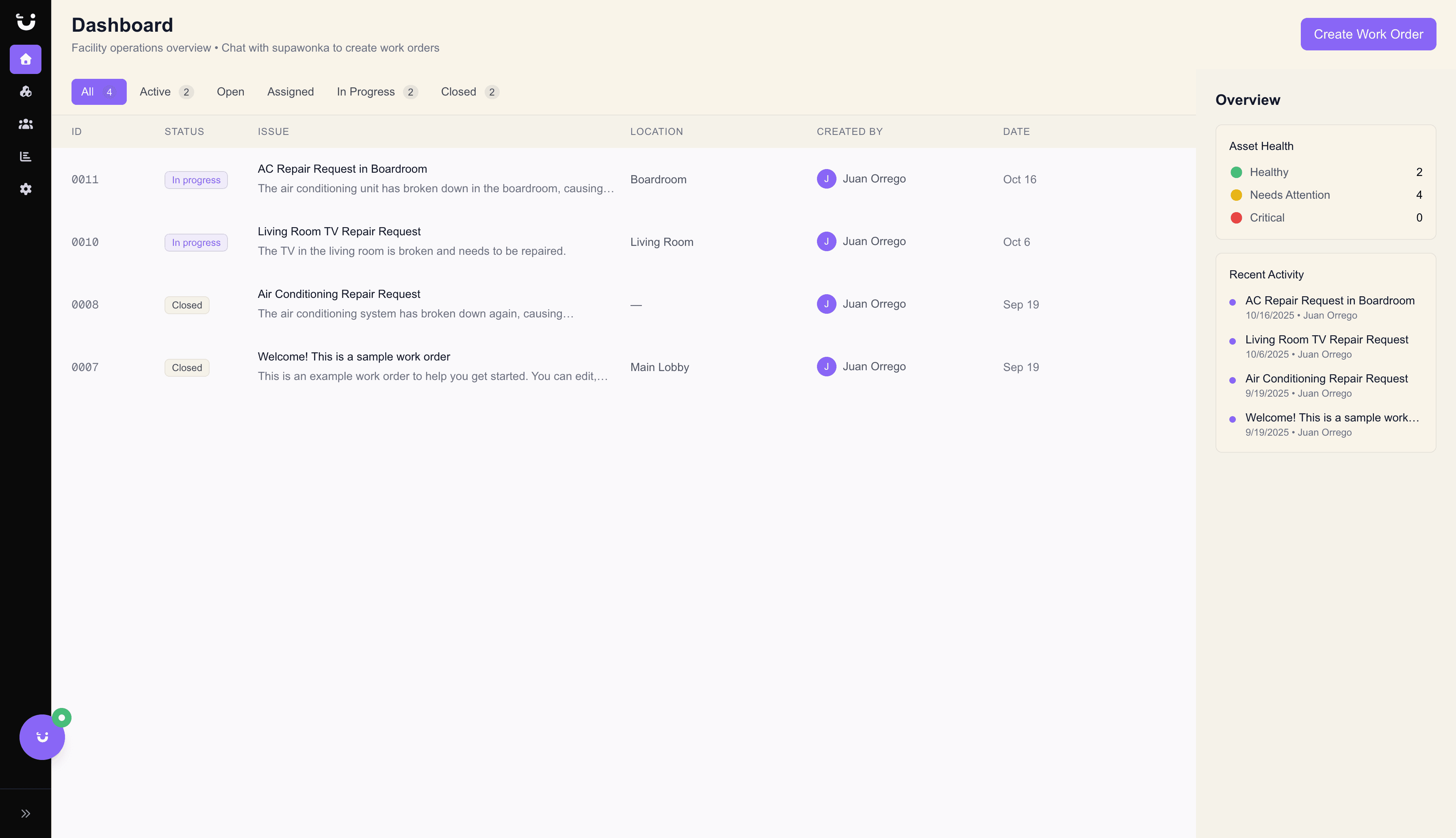
Manual spreadsheets lead to inaccurate data and low adoption. Platforms like Superwonka centralize work orders, vendors, assets, and performance.
2. Focus first on stability metrics
The first KPIs to stabilize are:
PM compliance
Reactive vs preventive ratio
Work order completion rate
Backlog
These form your operational foundation.
3. Assign ownership
Every KPI should have a clear owner (technician, supervisor, vendor, or manager).
4. Create weekly and monthly reporting rhythms
Operational consistency matters more than the metrics themselves.
5. Benchmark and improve continuously
Track KPI trends quarterly, not just monthly.
How Superwonka Helps Teams Track Facilities Management KPIs
Superwonka consolidates work orders, vendor performance, asset health, and operational workflows into one platform, enabling teams to:
Automate KPI tracking
Visualize technician and vendor performance
Reduce reactive maintenance through automated workflows
Improve PM compliance with scheduled reminders
Create accountability through real-time analytics
Streamline communication between operations, vendors, and staff
As teams reduce chaos and increase predictability, KPI performance naturally improves.
Conclusion
Tracking Facilities Management KPIs is not just about measurement. It is how operations teams build stability, reduce downtime, and demonstrate value across the organization. High-performing facilities programs use KPIs as a strategic framework for workflows, staffing, vendor performance, and asset reliability.
As facility operations become more complex, the organizations that rely on clear KPIs and modern platforms will outperform those that rely on guesswork and manual reporting.